Phosphate homeostasis, monitoring and managment of hyperphosphatemia in patients with the Chronic Kidney diseases
3. Parathyroid hormone (PTH)
Parathyroid hormone (PTH) is an important hormone that controls calcium and phosphate concentration through stimulation of renal tubular calcium reabsorption and bone resorption. PTH also stimulates the conversion of 25- hydroxyvitamin D to 1,25 dihydroxy vitamin D in renal tubular cells, which promotes intestinal calcium absorption as well as bone turnover.
Parathyroid hormone is synthesized, processed, and stored in parathyroid cells. Parathyroid hormone is secreted by exocytosis within seconds after induction of hypocalcemia. In circulation, parathyroid hormone is rapidly taken up by the liver and kidney, where it is cleaved into active amino- and inactive carboxyl-terminal fragments that are then cleared by the kidney. Intact parathyroid hormone has a plasma half-life of two to four minutes.
Any change in ionized calcium concentration gets sensed by calcium-sensing receptor (CaSR) on the surface of parathyroid cells, Increase in calcium activates these receptors, which inhibit parathyroid hormone secretion and decreases renal tubular reabsorption of calcium through second messengers.
Hypocalcemia, induced by increased phosphate levels, can also produce these effects. However, changes in phosphate concentration should be significant to produce substantial changes in serum calcium. Hyperphosphatemia can also directly stimulate parathyroid hormone synthesis as well as parathyroid cellular proliferation.
Figure. Role of phosphate retention in the pathogenesis of secondary hyperparathyroidism
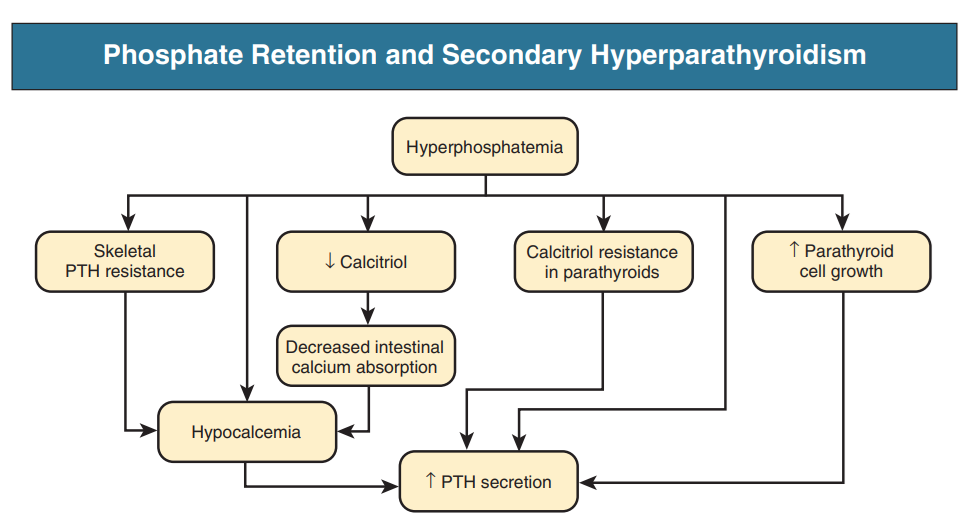
(Hyperphosphatemia stimulates parathyroid hormone (PTH) secretion indirectly by inducing hypocalcemia,
skeletal resistance to PTH, low levels of calcitriol, and calcitriol resistance. Hyperphosphatemia also has
direct effects on the parathyroid gland to increase PTH secretion and parathyroid cell growth. eGFR, Estimated
glomerular filtration rate)
Several drugs, such as penicillin, corticosteroids, some diuretics, furosemide, and thiazides, can induce hyperphosphatemia as an adverse reaction.