Topic outline
GENERAL
We welcome you to course of "Sustainable Nutrition"
This course explores the challenges of eating well around the globe considering environmental and economic factors, as well as access to and availability of nutritious food. Relying on the disciplines of food and resource economics, food science, and human nutrition, the course investigates and reflects on the contemporary international issues of global nutrition and sustainability from both economic and health perspectives. Major themes include the economics of global food systems, the growing problem of food waste, the implications of population growth, the impact of various eating patterns (e.g. animal sourced proteins, vegan, vegetarian, etc.) on the environment, the issues of food security and sustainability, and the elusive meaning of “healthy” eating.
Course duration- 2 ECTS (50 hours)
Goals of the course: In this course, students will investigate issues related to world hunger, access to nutritious food, food deserts. Students will also explore the emotional and cultural connections to food.
After completion of the course students will be able to:
-examine issues in land access and food production demands, explore potential uses of non-productive land, and investigate the influence of a consumer-driven economy.
-understand how diet, health and food production is changing, why food security and sustainable agriculture is essential, and how we can make positive future steps.-recognize how you, as an individual, and you, as a part of a community, can personally contribute now and in your career to addressing food security, sustainability, and environmental issues
Lesson 1: An introduction to sustainability
The purpose of the lesson: understand the basic concepts of the «Food System»
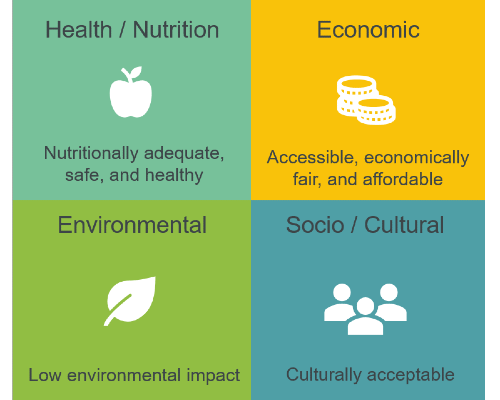
A sustainable food system is a food system that delivers food security and nutrition for all. The system encompasses everything from the processing, packaging and the transporting of food to consumers. Currently, these systems are not efficient or sustainable, and in 2022, about 9.2 per cent of the world population was facing chronic hunger, equivalent to about 735 million people – 122 million more than in 2019. In addition, these unsustainable practices are one of the main contributors to the climate crisis – they account for a third of greenhouse gas emissions and 70 per cent of the usage of the world’s freshwater.
There are three key indicators of whether a food system is sustainable or not:
- Economic sustainability – it is profitable throughout
- Social sustainability – it has broad-based benefits for society
- Environmental sustainability – it has a positive or neutral impact on the natural environment
By the end of this lesson, you will:
1. Understand the role of Sustainable Food System at the local, national, regional and global levels.
2. Describe the role of Food policies to health health of population.
3. Discuss the role of Food System for population
4. Describe the impact of unsustainable nutrition on the burden of disease including on non-communicable disease.
TASK: Please read the article before classSustainable nutrition (30 mins) then read Principle guidlines of Healthy diet (30 mins)
Task in English:
This task will take 60 mins
- Please divide into groups of 2-3 people.
- Create an infogram of your habits that contribute to sustainable development.
- Post your infogram here in this assignment and on Instagram using #SDG.
- Take screenshot of your infogam in instagram and attach it to the task
Translated with DeepL (06.03.2024)
Task in Russian - Задание на русском языке:
- Пожалуйста, разделитесь на группы по 2-3 человека.
- Создайте инфограмму своих привычек, которая будет способствовать устойчивому развитию.
- Опубликуйте свою инфограмму в Instagram, используя #SDG.
Group project
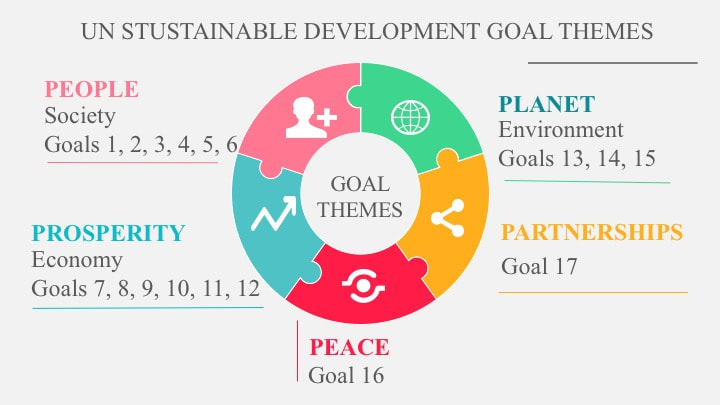
Group-Project:
During this course you'll be doing a group research project. Research question: How can we make our community diet culture and food supply more sustainable.
During each class you'll do a task that is a part of your project. During class 8 you'll present your work.
Grading: project contributes to 50% of your final grade
Lesson 2: Food and food system
Purpose of the lesson : To know current problems facing the Food System recognize the importance of food and Food System evaluate Food Processing and Food Distribution Network
By the end of this lesson, students will:
1. Know about "Global issues in the food supply chain"/ Where Does Food Come From?2. Understand the impact of various eating patterns (e.g. animal sourced proteins, vegan, vegetarian, etc.).
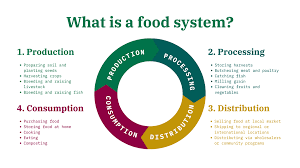
3. Understand how to evaluate the interconnectedness of food systems and planetary health, and synthesize the meaning of sustainability in the context of a food system.The global food system consists of agricultural production, processing, distribution, retail operations, consumption, and waste management. Technologies used throughout the food system vary with the degree of industrialization. In many parts of the world, the food system is complex with elaborate food processing and distribution operations. In other areas, the food system might be as simple as transport of raw goods from the farmer to the consumer.
The current food system does not adequately meet the need of the world. Approximately 1200 million people live on less than US $1 a day. In 2005, an estimated 1.8 million people died of diarrheal diseases annually. These statistics point to a need for modification of existing policies and regulations to improve safe food production and efficient food distribution. Other topics of concern in world agriculture today include food safety and intentional contamination, the long term impact of genetic modification of crops, food security and ensuring a sufficient and nourishing food supply, and traceability of food items in commerce. This chapter discusses these areas and the impact these issue may have on agricultural sustainability across the world.Current Problems Facing the Food System
It is critical to improve food production and distribution systems to avoid rampant poverty and starvation. At present, the global food system does not adequately meet the needs of the world’s population. About 820 million people are living with hunger. Ironically, the food supply is the least secure for agricultural workers who are among the most malnourished and impoverished individuals. Chronic infrastructure problems with the food system are a major underlying cause of this problem including: a lack of inputs such as available clean water and energy, seed, fertilizer, and implements. Soil degradation and either inappropriately developed or poorly capitalized production and distribution systems result in inefficiencies even when inputs are adequate. A lack of suitable farm-to-market transport, financing and communications are other critical factors which negatively impact the food system at all levels. Water management is potentially the greatest risk to food security. In much of the developing world, over two-thirds of the available water resources are committed to irrigation. This is a particular concern in sub-Saharan Africa where water resources are oversubscribed by up to 70%, a situation currently facing Botswana. Agricultural and food processing practices have contributed to inadvertent detrimental changes to the natural environment including desertification, eutrophication of bodies of water, deforestation, flooding, and silting that has led to reduced agricultural productivity in large parts of Asia, Africa, Central and South America and Australia.
The Importance of Food
The Importance of Food Food is an essential ingredient for human life. It serves as the source of energy and nutrients for the biological activities of the human body. Production, processing, distribution and sale of foods are an integral part of modern economics and the basic fabric of human society. Raw materials for foods are produced mainly by agricultural activities, although some products are gathered from nature (e.g. mushrooms and medicinal plants) or hunted (e.g. marine and freshwater fish and shellfish, wild game). All food products are perishable relative to other natural materials in commerce such as forest products and fuel. Food products require the use of preservation measures to make them stable, safe for consumption, and extend shelf-life. Products such as fresh produce, muscle foods, and fluid milk have no more than 10 days shelf life even with the use of the best current technologies available. Almost all of our food products require the use of processing technologies to add value so that they can be held past the immediate harvest period. Many different processing methods are available to make food ingredients or products more convenient to use.
Food System
The food system is a complex network of stakeholders that function cooperatively to feed the world’s population. The system includes farming, raw material shipping and handling, processing, distribution, vending, consumption, and waste disposal. For the overall process to be effective and sustainable, the food system must yield products that are safe, accessible, nutritious, and with acceptable sensory characteristics. The food system should be environmentally sustainable, and provide economic values to the regions which support it.
A connection often exists between producers and consumers. Bazaars in many parts of the world are still the major retail food markets and even in developed countries, consumers commonly purchase fresh produce from local farmer’s markets. Otherwise feedback to farmers from consumers is less direct. The extent to which a producer communicates with a retailer or consumer depends upon geographic and economic factors as well as the nature of the products being sold. Fresh produce sold in retail markets often involve fewer steps in the supply chain from the producer to the consumers compared to processed products such as thermally processed foods, frozen foods, bakery or snack foods. However, certain categories of those produce are the most highly engineered foods currently sold in the marketplace.Please read:
TECHNICAL NOTE ON SUSTAINABLE FOOD SYSTEMS (90 mins)
Article 1. Sustainability of food system in 21st century (90 mins)
Article 2.Overview of food system challenges (90 mins)In this video, we will look at food system and their characteristics (4 mins)
In this video, we will look at food system are more than what we eat (1 mins)
For clarity, list two points to explain what an Industrial Food System is and two points to explain what a Peasant Food Web is. These points can be examples or explanations.
Think back over this past week and the food that you consumed. Do you rely more on the Industrial Food Chain or the Peasant Food Web for your food? Explain and discuss.
Submit your work in this assignment!
Grading for this activity: Pass or Fail.
Timing: 20 minsMake a mind map of food sources, food waste and food lost, food supply chain in your area.
You need this step for Task 3 of Lesson 2 below!
Grading for this activity: Pass or Fail.
Timing: 60 minsGo to https://sdg360thinking.org/
Sing in and get aquainted with SDG 360 Thinking tool. Include all your ideas from mind map and make a graph using SDG 360 Thinking tool.
Click on the button "Add discussion topic" below and write your results and opinions. You will see the answers of your colleagues only after you have posted your own. Write 2 replies to fellow students to spark the discussion!
Grading: Pass or Fail
Timing: 120 mins
Lesson 3: Food and society
Purpose of the lesson: understand the role of food in society and recognize how social norms as well as culture impact our view of food and review the following topic within food and society: Food inequality, food and sustainability, food and gender and lastly, food culture in the world.By the end of this lesson, students will:
1. Understand the influence of foodways and food systems on choices, behaviours and perspectives around food.
2. Know the relationship of food and disease.
3. Be able to know the role of food in social inclusion and the welfare state.
4. Understand nutrient requirements across the life course.
Before class please read the articles:Why We Eat the Way We Do: A Call to Consider Food Culture in Public Health Initiatives (60 mins)
The cultural dimension of food (30 mins)
In class first 40 mins we will discuss readings:
1. What are main challanges in modern food culture?
2. Do you think that health promotion is a part of food culture in your community?
3. Please describe food culture of your community.
In class watch Video 1 about Food and Culture (2 mins) and Video 2 about Food, Culture and Society:In class discuss for 40 mins:
1. What are the main patterns of food culture in your family, group, community and University
2. What are main food challanges in your culture?On an individual level, we grow up eating the food of our cultures. It becomes a part of who each of us are. Many of us associate food from our childhood with warm feelings and good memories and it ties us to our families, holding a special and personal value for us. Food from our family often becomes the comfort food we seek as adults in times of frustration and stress.
Questions:
- Make a list of some of your comfort foods.
- What aspects make these foods comforting (e.g. smell, ingredients, taste, the person who makes it...)
- Are these comfort foods traditional to your country and/or culture?
Grading for this activity: Pass or Fail.
Timing: 60 mins- Make a list of some of your comfort foods.
On a larger scale, food is an important part of culture. Traditional cuisine is passed down from one generation to the next. It also operates as an expression of cultural identity. Immigrants bring the food of their countries with them wherever they go and cooking traditional food is a way of preserving their culture when they move to new places.Continuing to make food from their culture for family meals is a symbol of pride for their ethnicity and a means of coping with homesickness.
Questions:
1. Have you tried another cultures food?
2. Besides the taste of the food, list the other elements that you think might be important in experiencing another culture s food (e.g. the smell of the food, the environment you are in, the story of where the food comes from ……).
Click on the button "Add discussion topic" below and write your results and opinions. You will see the answers of your colleagues only after you have posted your own. Write 2 replies to fellow students to spark the discussion!
Grading for this activity: Pass or Fail.
Timing: 60 minsGroup-Project Part 1: In your group write a literature review on “Dietary trends in my country and factors that formed them”
Timing: 2 weeks
The literature review should include:
- At least 15 sources
- For literature review please find 2 literature reviews that align with your topic
- Use pubmed data base (if available use Scopus or Web of Science) to find articles
- Format for literature review
- Topic:
- Authors:
- Key words:
- Timing:
- Background|Introduction:
- Methodology: Data base, inclusion and exclusion criterias, number of articles found and included
- Main part:
- Conclusion:
Lesson 4: Diets for healthy living
Lesson aim: identify social determinants of eating around the world and discuss the impact of different eating styles on health.After this lesson students will:
1. Understand the role of modern dietary patterns in health and disease.
2. Determinants of dietary patterns around the world and discuss the impact of different eating styles on health.3. Evaluate the Mediterranean Diet (MD), Dietary Approaches to Stop Hypertension (DASH), Traditional Asian Diets.
The definition of what constitutes a healthy diet is continually shifting to reflect the evolving understanding of the roles that different foods, essential nutrients, and other food components play in health and disease. A large and growing body of evidence supports that intake of certain types of nutrients, specific food groups, or overarching dietary patterns positively influences health and promotes the prevention of common non-communicable diseases (NCDs). Greater consumption of health-promoting foods and limited intake of unhealthier options are intrinsic to the eating habits of certain regional diets such as the Mediterranean diet or have been constructed as part of dietary patterns designed to reduce disease risk, such as the Dietary Approaches to Stop Hypertension (DASH) or Mediterranean-DASH Intervention for Neurodegenerative Delay (MIND) diets. In comparison with a more traditional Western diet, these healthier alternatives are higher in plant-based foods, including fresh fruits and vegetables, whole grains, legumes, seeds, and nuts and lower in animal-based foods, particularly fatty and processed meats. To better understand the current concept of a “healthy diet,” this review describes the features and supporting clinical and epidemiologic data for diets that have been shown to prevent disease and/or positively influence health. In total, evidence from epidemiological studies and clinical trials indicates that these types of dietary patterns reduce risks of NCDs including cardiovascular disease and cancer.
Please read before class
1. «Food, planet, health» (EAT-Lancet commission) 60 mins.
2. Nutrition and environment. 60 mins
3. Importance of Good Food for healthy lifestyle. 60 mins
In class first 40 mins discuss readings
- What are social determinants that affect dietary behaviour in your community, family, University
- How your and your group's food lifestyle effects environment
- Do you consider your University lifestyle healthy? Why?
- Is there any dietary pattern you want to change?
In class watch videos 1. Healthy eating 15 mins
Source: Michael Evans and Reframe Health Films Inc.
And watch video 2. Food for the future
In class for 40 mins please discuss videos
- What are the dietary patters in your community, family, University that contributes the most to the environment
- Do you think it can be changed? Why?
Many open their own restaurants and serve traditional dishes. However, the food does not remain exactly the same. For example, some ingredients needed to make traditional dishes may not be readily available, so the taste and flavour can be different from the taste and flavour of the dishes that they would prepare in their home countries.
Additionally, when immigrants sell food in another country, they do not only sell it to people from the same countries as them, but to people from different countries.
Therefore, they have to alter the original dishes to cater to a wider range of customers with distinct tastes and flavour preferences. Alterations to original dishes can create new flavours that still retain the cultural significance of the dish.
What stays the same though is the extent to which each country or communitiess unique cuisine can reflect its unique history, lifestyle, values, and beliefs.
Questions:
- Write down as many foods as you can think of that has been slightly altered from its traditional version (e.g. sweet sushi)?
- What do you think are the positives and negatives of this kind of alteration and diversity of food?
Click on the button "Add discussion topic" below and write your results and opinions. You will see the answers of your colleagues only after you have posted your own. Write 2 replies to fellow students to spark the discussion!
Grading for this activity: Pass or Fail.
Timing: 60 minsGroup-Project: Part 2
Timing: 1 week
After analyzing literature on sustainable dietary recommendations in your community, please create a video to post on instagram: “Easy ways to follow country nutritional guidelines”
- Post your video on Instagram
- Submit your video in this assignment
Grading for this activity: Pass or Fail.
Lesson 5: Food security and climate change

Purpose of the lesson : describes some factors affecting food security and explain the methods that are used to increase food production and understanding of the main food safety principles and the importance of following food safety procedures
By the end of this lesson, students will be able:
1. to analyze differences between food safety and security and impact of them to climate change.
2. to know impacts of Climate Change on Food Utilization and impacts of climate change on access to food.The latest data from the World Health Organization (WHO) suggests that each year, foodborne illnesses cause almost one in 10 people on the planet to fall ill . Some 420,000 deaths a year are believed to result from foodborne illnesses, a significant proportion of these in children less than five years old. Contaminated food causes some 230,000 diarrheal deaths a year; this is the best estimate of the global impact of foodborne illness that we have yet seen, and represents a heroic effort on the part of the WHO, having required 10 years to compile. This figure may nevertheless still be an underestimate.
Food security is commonly understood as the state when all people at all times have physical, social and economic access to sufficient, nutritious and safe food to meet their dietary needs and food preferences for an active and healthy life. Conceptually, food security is built upon four pillars including food availability, access, utilization and stability. Within this framework, food safety is often wrongly assumed as a given. However, in places where food supplies are insufficient, coping mechanisms to address food insecurity are often primarily focused on access to food without due considerations for safety. Even in more food-secure countries, limited resources are diverted to ensure the safety of exported food products at the expense of food sold domestically. Individuals facing food insecurity are vulnerable to chemical, biological and other hazards in unsafe foods, which can pose serious, acute and chronic health risks (ranging from diarrhoea to cancer and even death)
Read following Articles and watch the videos:- Article 1 Food security and safety (10 mins)
- Article 2 Food Safety: A rightT or a privilege (10 mins)
- Article 3 The Critical Role of Food Safety in Ensuring Food Security (15 mins)
- Video 1 about Food Security:
Answer the question and give the full forms of the abbreviations!
Task: Create a recommendation pattern on food safety and upload your document in this assignment.
Grade: Pass or Fail
Group-Project Work: Part 3
In your project group, come up with 5-10 questions you can ask to analyse the food supply chain that shapes a community's diet. Create a survey to analyze food chain in your community.
Submit your work in this assignment!
Lesson 6: Sustainable diet

Purpose of the lesson: know how your food habits and daily choices are affecting your health and that of the planet and also identify howto make your diet more healthy and sustainable.
By the end of this lesson, students will be able:
- to explain what is at stake: how your food choices affect your health and the environment?
- to make better food choices that consider both human and planetary well-being
- to identify ways in which changing your diet makes a positive impact
- to develop a personal sustainable and healthy diet plan or project
The UN Committee on Economic, Social and Cultural rights has recognized that the right to adequate food is of crucial importance for the enjoyment of all human rights. The committee considers that “the right to adequate food implies: “The availability of food in a quantity and quality sufficient to satisfy the dietary needs of individuals, free from adverse substances, and acceptable within a given culture; The accessibility of such food in ways that are sustainable and that do not interfere with the enjoyment of other human rights” 1 . The Committee on the Rights of the Child has also recognized the obligation of States to ensure access to nutritionally adequate, culturally appropriate and safe food to combat malnutrition in all its forms 2 .
Nonetheless, many individuals do not have year-round access to safe, affordable, healthy diets needed to promote health and wellbeing. 3 As a result, malnutrition in all its forms is a problem of global proportion, and no country is free from its effects. One in three individuals is currently affected by at least one form of malnutrition such as hunger, stunting, wasting, micronutrient deficiencies, overweight and/or obesity as well as resulting diet-related, non-communicable diseases (NCDs). The consequences of malnutrition include avoidable ill-health and premature death, as well as enormous economic and societal costs. Global estimates suggest that malnutrition in all its forms costs society up to USD 3.5 trillion per year.Before class:
- Read the Article 1: Sustainable Diets as Tools to Harmonize the Health of Individuals, Communities and the Planet: A Systematic Review. (60 mins)
- Read the Article 2: Understanding Sustainable Diets: A Descriptive Analysis of the Determinants and Processes. (60 mins)
In class first discuss for 40 mins:
- Are dietary patterns of your community, family, University sustainable?
- What does your group 1 month food basket includes? How much does it cost?
- Would sustainable diet inclrease cost of your 1 month food basket?
Watch the lecture about Healthy and Sustainable Diet.EAT- Lancet Commission Approach Healthy and Sustainable Diet.EAT- Lancet Commission Approach
In class 40 mins discussion on videos:
- What is EAT Lancet Commission approach
- Calculate what will "PLATE" cost in your community
- Discuss food chain involved in formint the "PLATE" in your community
- What dietary patterns and recommendations are prevalent in your community?
Group project: Part 4
Choose a community and analyze it's food chain and how it affects their diet.
Ask 6-10 people.
Analyze their answers and make visiual graphs to describe your results
Timing: 1 week
Submit your work in this assignment!
Lesson 7 Sustainable nutrition future
Purpose of the lesson: analyze the effects of food on the body, society and the planet and compare their impacts on healthcare practice.
By the end of this lesson, students will be able:
- to reflect on the possible causes (biological, social, psychological) of unhealthy eating patterns
- to assess the current healthy guidelines and describe how they can be applied to different population groups
- to describe which types of foods are essential for health and wellbeing and summarise their important role in treating/preventing disease
- to describe the causes of unsustainable food production and consumption patterns
- to explain the relationship between food, nutrition, diets and human health in the context of sustainability.
In recent years, the importance of sustainability has become increasingly evident across various aspects of our lives, including the way we eat. Sustainable nutrition focuses on making conscious choices that not only benefit our health but also protect and preserve the environment. In this blog, we will delve into the concept of sustainable nutrition, its significance, and practical tips for adopting a more eco-friendly and health-conscious diet.
Sustainable nutrition is a holistic approach to food consumption that seeks to meet our nutritional needs while minimizing negative impacts on the environment and supporting local communities. It acknowledges the intricate relationship between human health, the health of the planet, and social equity. By adopting sustainable dietary practices, we contribute to the conservation of natural resources, reduce greenhouse gas emissions, and support ethical agricultural practices.
Before lesson read Copenhagen city food strategy and interview of Dr.Pekka Puska on experiment in North Karelia (FL) (120 mins)
In class discuss for 40 mins:
- How Copenhagen city organized it's food chain
- What were the barriers for adaptation of the new food model
- How people of Copenhagen are educated to embrace new behaviours
- How North Karelia citizens were involved in complete dietary change program?
- What were the challenges of North Karelia experiment?
- What do we need to change a behaviour in a community?
- Provide examples of fast dietary behaviour change in your community. Describe determinants involved in that change? How this change was possible?
Group-project: Part 5
Use your survey results from part 4 to make suggestions on food chain change and behavioural changes that could be introduced into your community to create more sustainable diet culture.
- What would you change?
- How you will change that?
- Who are stakeholders for this change?
- Choose one stakeholder and explain how will you change behaviours in that group, make a 2 pitch to promote that change.
Timing: 1 week
Submit your work in this assignment!
Lesson 8: Final group-project presentation and Exam
Assessment of knowledge

Present your Project in class!